Pizza Margherita
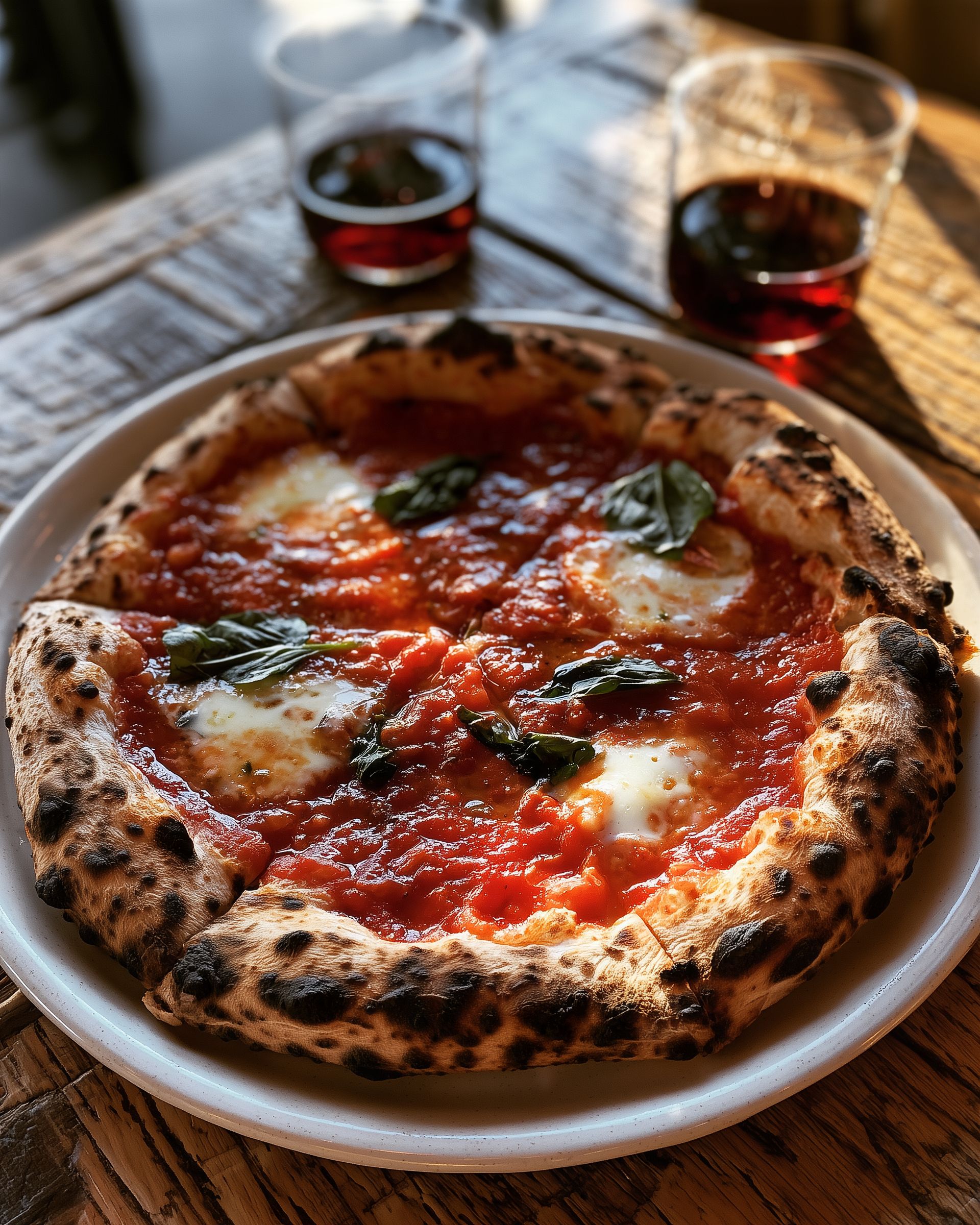
This is Matteo's dough, stretched thin and topped with almost nothing, which is exactly the point, though not everyone agrees with it at first glance. People ask for more mozzarella more often than they ask for anything else in this restaurant, and more often than not, that's exactly what they get -- my father has strong opinions about the classic proportions, but stronger ones about sending a customer away happy, and the extra cheese usually wins.
Ingredients
- 1 ball Impasto per Pizza a Lievitazione Lenta, risen and at room temperature (see previous chapter)
- 100g canned San Marzano tomatoes, crushed by hand
- 100g fresh mozzarella (fior di latte), torn into small pieces
- A few fresh basil leaves
- Extra virgin olive oil
- Fine sea salt
- Semolina or flour, for dusting
Makes one 12-inch pizza.
Cookware Required
- la pietra o l'acciaio refrattario (pizza stone or steel)
- la pala per pizza (pizza peel)
- una ciotola piccola (a small bowl, for crushing the tomatoes by hand)
Method
At least forty-five minutes before you plan to bake, put your pizza stone or steel into your kitchen oven and set it to its highest setting -- for most home ovens, this tops out somewhere around 550°F (290°C), nowhere near a true pizza oven's heat, but far hotter than the oven ever runs for anything else you cook in it. At that temperature, on a well-heated stone, expect the pizza to take anywhere from fifteen to thirty minutes, depending on how thick you have stretched it and how much you have put on top. This is not a fast recipe in a home oven, and it is not supposed to be.
If you are lucky enough to have a dedicated pizza oven -- gas, wood-fired, or otherwise -- running at 700°F (370°C) or hotter, nearly everything above changes. The oven itself is the cooking chamber, and there is no forty-five-minute stone to wait on; once it has come up to temperature, it holds it. A pizza will blister, char, and finish in under two minutes, sometimes closer to ninety seconds, and the only real danger is looking away, since the distance between perfect and burnt happens faster than most people expect.
Crush the tomatoes by hand in a small bowl with a pinch of salt -- do not blend them, or you will lose the texture that makes this sauce feel rustic instead of processed.
Dust your work surface generously with semolina, and stretch the dough by hand, working from the center outward and letting gravity help you, turning it as you go. Never use a rolling pin for this. A rolling pin pushes the air out of the dough that the last three days were spent building into it.
Transfer the stretched dough to your floured peel, and check that it slides freely before you add anything on top -- this is the moment to discover a stuck pizza, not after it is dressed. Spread the crushed tomato thinly, leaving the outer rim bare, scatter the torn mozzarella, and add nothing else. Not yet.
Slide the pizza onto the hot stone or oven floor, and watch it instead of a clock -- the crust should blister and char in spots, and the cheese should fully melt, whichever timeline your oven allows. This is not a recipe you can walk away from, in a home oven or otherwise, though a proper pizza oven gives you far less time to reconsider that decision.
The moment it comes out of the oven, tear the basil leaves over the top by hand rather than laying them on before baking, where they would only blacken and turn bitter, and finish with a thin drizzle of raw olive oil.
Quando Va Storto
If the center comes out soggy instead of set, you used too much tomato or too much cheese, or your oven was not as hot as you believed it was; next time, use less of both, and give the stone longer to fully heat through. If the crust never blisters or chars at all, your oven has not reached a true pizza temperature, or -- in a home oven -- the stone was not given enough time to absorb the heat; forty-five minutes there is a minimum, not a suggestion. If the dough tore while you were stretching it, it had not rested long enough at room temperature, or you handled it roughly instead of letting gravity do the work. And if the basil came out black and bitter, it went on before the oven rather than after -- it should never see the inside of the oven at all.
Una Storia dalla Sala
A quiet man came in alone on an ordinary Tuesday, ordered a Margherita, watched the dining room more than his plate, and left an unremarkable tip on an unremarkable evening nobody thought twice about. Three weeks later, Chiara found his review in a food magazine one of our suppliers had left in the kitchen, and read it aloud to the entire staff before anyone had finished their coffee. He'd spent most of it not on the pizza itself, but on the fact that nobody had treated him any differently than the family at the next table -- no fuss, no performance, simply the same attention everyone else in the room was already getting.
My father has read that review, by Chiara's count, at least two hundred times since, and still insists, unconvincingly, that it doesn't mean anything to him.